
Healthcare websites carry a genuinely different weight than most other business sites. Patients are searching for care while anxious or in pain, providers need to publish accurate information quickly, and there are real legal obligations around how patient information is handled, even on the public-facing parts of a website. A CMS choice that seems fine for a typical business can quietly become a liability in healthcare if it doesn't hold up under those specific pressures.
Kentico comes up regularly in healthcare CMS evaluations, particularly for hospital networks, clinic groups, and health systems. Let's look at why, and where the real considerations actually lie.
What healthcare websites actually need
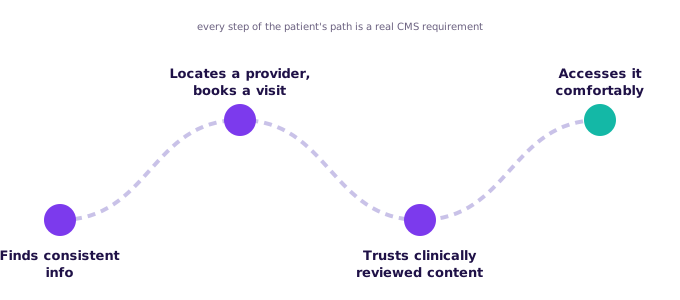
Before getting into Kentico specifically, it's worth being clear about what makes healthcare sites different from a typical business website.
You're usually managing content across many locations and departments, individual clinics, specialists, service lines, each needing their own pages while staying consistent with the broader health system's branding. You need a genuinely reliable provider directory and appointment scheduling experience, since this is often the single most-used feature on the entire site. You need careful control over who can publish what, since medical content often requires clinical review and approval before it goes live, not just a marketing sign-off. And you need to think seriously about accessibility and data privacy from the start, not as something bolted on after launch.
A CMS that treats every page as a generic, one-off piece of content tends to struggle once a health system reaches any real scale.
Where Kentico's structure tends to help
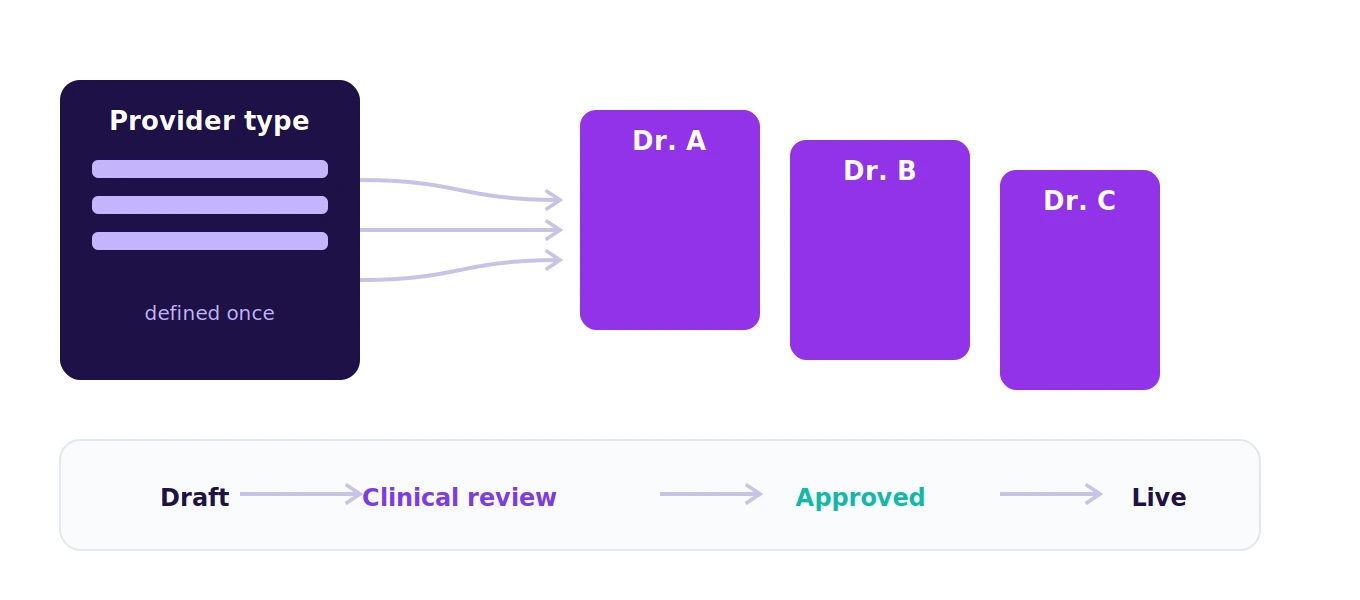
Kentico's content modeling approach, defining reusable content types with specific structured fields, maps reasonably well onto healthcare's need for consistency across many similar pages. A "Provider" content type with fields for specialty, credentials, locations, and accepted insurance can be defined once and reused across hundreds of individual provider pages, keeping them consistent without manually rebuilding each one.
Kentico's built-in workflow and content approval features are also genuinely relevant here. Healthcare content often needs a review step, clinical accuracy checked by someone qualified to verify it, before publishing, and having that approval process built into the CMS rather than managed entirely over email or Slack is a real practical advantage.
Multi-site management matters too, for health systems running a main hospital site alongside individual clinic or specialty microsites, managing all of that from one platform rather than treating each as a separate, disconnected project is a meaningful efficiency gain.
The compliance question, answered honestly
This is the part that deserves real care rather than a confident, sweeping claim either way.
A CMS itself is not what makes a healthcare organization compliant with regulations like HIPAA in the United States, or equivalent healthcare data protection rules elsewhere. Compliance depends on how the entire system is configured, hosted, and operated, encryption practices, access controls, business associate agreements with hosting providers, staff training, and a long list of operational practices that go well beyond which CMS platform sits underneath the website.
What a CMS can do is provide a solid technical foundation that supports compliant practices, role-based permissions, audit trails, secure hosting options, without those pieces already being in place. Whether Kentico, or any CMS, is being used in a way that's actually compliant depends entirely on your specific implementation, hosting setup, and organizational processes.
If compliance is a major factor in your decision, and for healthcare it should be, the right move is to have your specific regulatory requirements reviewed directly against current, official Kentico documentation, and ideally with input from your legal, compliance, and IT security teams, rather than relying on general marketing claims from any CMS vendor, including general overview content like this.
What to actually weigh
Kentico requires .NET development expertise, a smaller talent pool than something like WordPress, so factor that into your evaluation if your organization doesn't already have that resource in-house or through a trusted development partner.
The upfront investment in defining your content structure, provider types, service line templates, multi-site architecture, takes real planning time before you see the payoff. This tends to be worth it specifically at the scale of a multi-location health system, and less clearly worth it for a single clinic or small practice website, where a simpler platform might get you where you need to go with less overhead.
Is it the right fit for your healthcare organization?
If you're managing a genuinely large number of locations or providers, need structured content with a real approval workflow, and have access to .NET development resources, Kentico is a platform worth serious evaluation, alongside comparable enterprise options like Sitecore or Optimizely.
If you're running a single clinic or small practice site, the structural benefits that make Kentico compelling at scale may not be worth the added setup complexity compared to a simpler, more accessible platform.
Whatever platform you land on, treat the compliance question as its own dedicated conversation with the right internal and legal stakeholders, not a checkbox you can tick off based on any CMS vendor's marketing page.
If your organization has implemented Kentico, or evaluated it for a healthcare website, we'd genuinely like to hear how that process went, what mattered most in the decision, and what you'd tell another healthcare organization considering the same path.