
Manufacturing websites tend to carry a kind of complexity that doesn't show up in a typical business site. A single manufacturer might sell thousands of SKUs across multiple product lines, offer configurable products where the final specification depends on what the customer selects, and operate under several brand names across different regions, all while buyers expect a research experience that feels more like a modern e-commerce site than a static digital catalog from a decade ago.
Kentico shows up regularly in these evaluations, largely because its architecture was built to handle exactly this kind of structured complexity in one place rather than stitching several separate systems together. Let's look at why, and where the real tradeoffs sit.
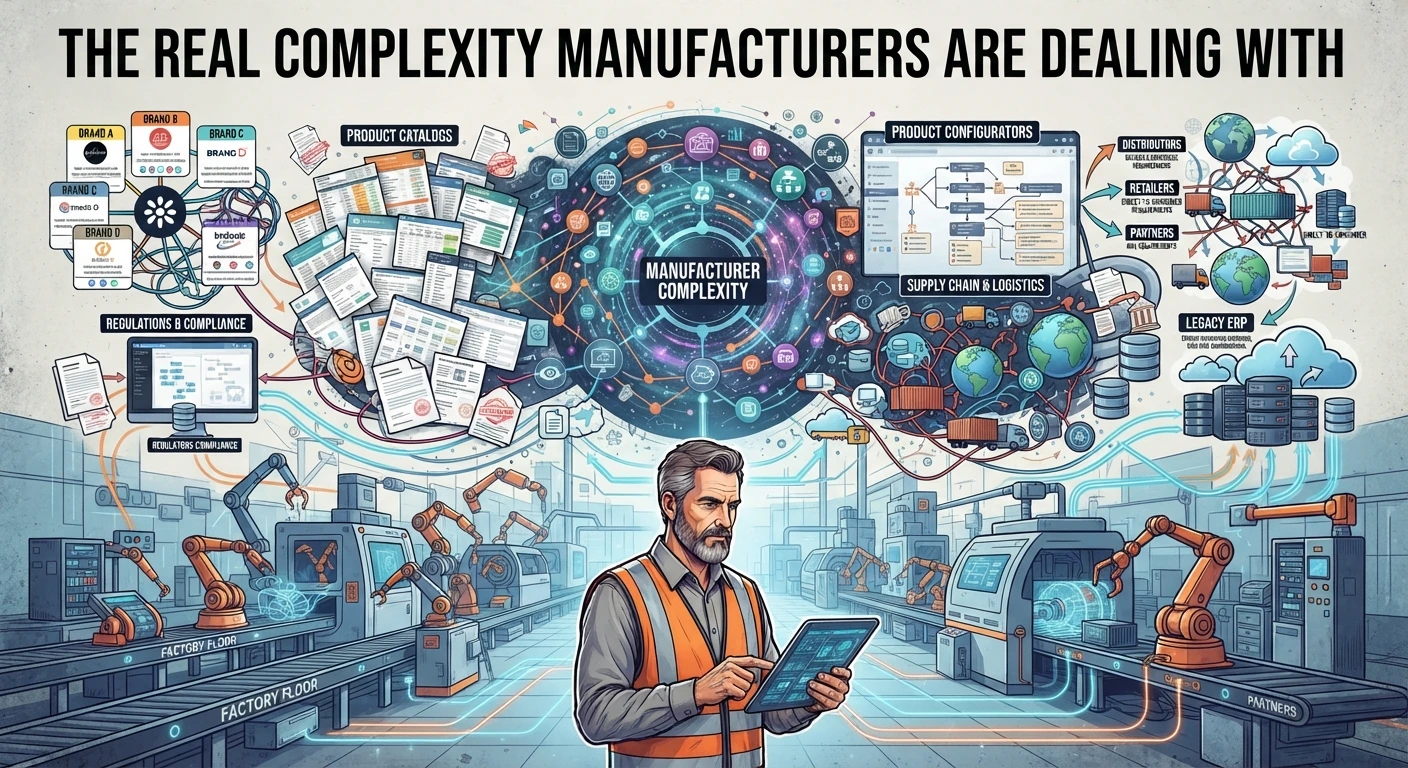
Before getting into the platform itself, it's worth naming what actually makes manufacturing sites hard to manage well.
Product catalogs are often enormous and deeply structured, with variants, specifications, certifications, and technical documents attached to each item, not just a name, price, and photo. Configurable products add another layer entirely, where the website needs to guide a buyer through a series of choices and reflect how those choices affect specifications, compatibility, and pricing. Multi-brand operations mean managing several distinct web presences, sometimes with completely different visual identities, from a single backend rather than treating each brand as an unrelated, separate project. And B2B buyers researching manufacturing products tend to take a long, document-heavy path before ever contacting sales, so the content experience has to support real research, not just a product listing.
A platform that treats every product as a one-off content item, with no real structure connecting them, tends to become unmanageable once a catalog reaches any real scale.
Where Kentico's structure helps with catalogs
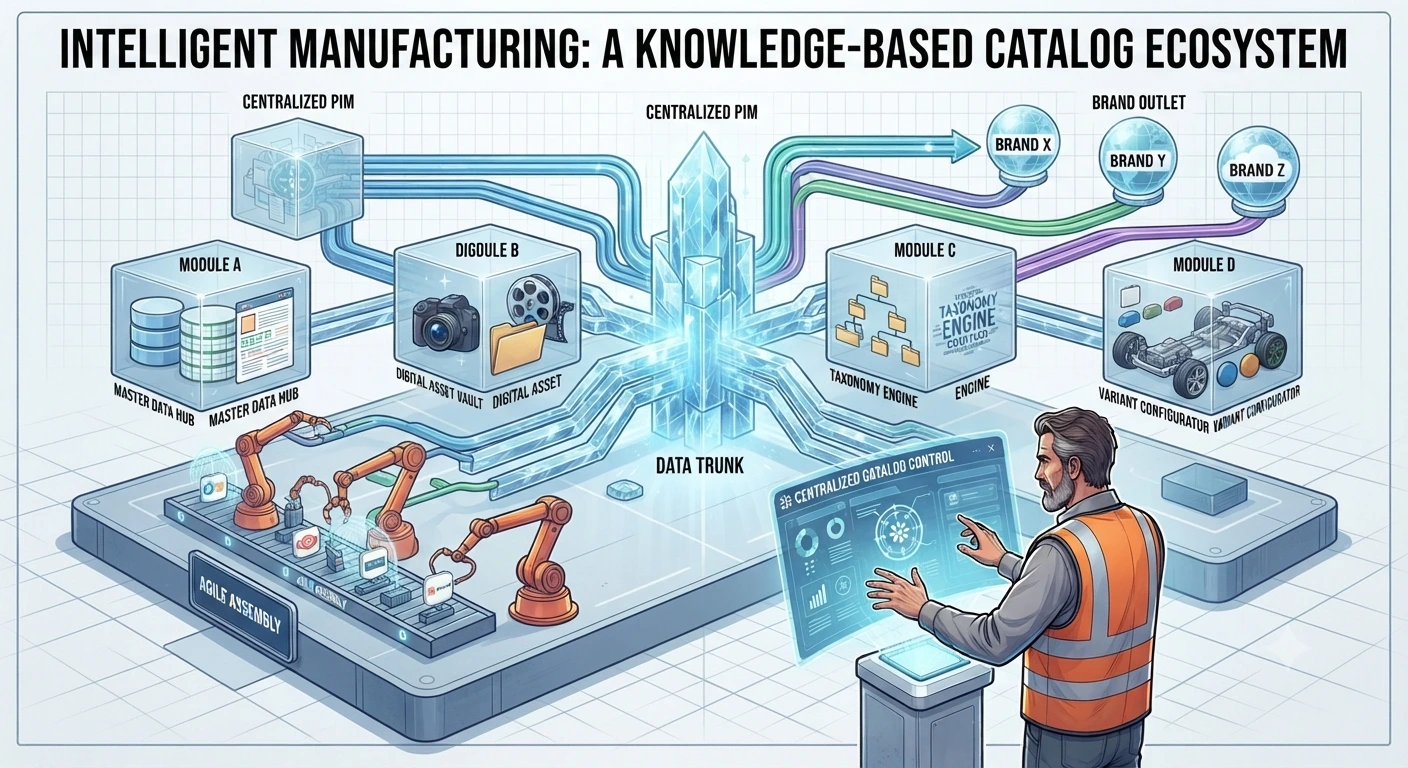
Kentico's content modeling approach lets you define structured content types with specific fields, which maps naturally onto manufacturing product data. A "Product" type can include fields for specifications, certifications, compatible accessories, and downloadable documents, and that same structure applies consistently across every product in the catalog, however many thousand that turns out to be.
This structure also supports relationships between content types in a way flat page-based systems struggle with, linking a product to its category, its compatible accessories, related technical documents, and even multiple SKUs or variants under one parent product. For manufacturers managing serious SKU volume, this relational approach is usually what actually makes a large catalog manageable rather than chaotic.
Configurators: what the CMS can and can't do alone
It's worth being direct here, since this is often oversold in platform marketing generally: a CMS like Kentico is not, on its own, a product configurator engine. Configurators, the interactive tools that let a buyer build a custom product specification step by step, typically involve dedicated configuration logic, often a separate specialized tool or custom-built application, that handles the actual rules about which combinations of options are valid and how they affect specs or pricing.
What Kentico does well is serve as the content and presentation layer that configurator tools integrate into, through its API capabilities, so the configurator experience feels like a native part of your site rather than a bolted-on third-party widget, and the content around it, specifications, documentation, related products, stays consistently managed within the same platform. If a configurator is central to your sales process, plan for it as its own piece of the architecture, not something Kentico delivers automatically out of the box.
Multi-brand management from one platform
This is one of the areas where Kentico's architecture tends to show real, practical value for manufacturers. Multi-site management lets you run several distinct brand websites, each with its own design, domain, and content, from a single backend instance, rather than maintaining entirely separate CMS installations for each brand.
This matters practically in a few ways. Shared product data can be reused or referenced across brand sites where it genuinely overlaps, rather than being manually duplicated and risking inconsistency. Your technical and content teams work within one system rather than needing separate expertise and processes for every brand. And rolling out a new regional or brand-specific site becomes faster once the underlying structure already exists, rather than starting from zero each time.
What to weigh before committing to this approach
Kentico requires .NET development expertise, a smaller talent pool than something like WordPress, so this is worth factoring in honestly if your organization doesn't already have that capability in-house or through a trusted development partner.
The upfront investment, defining your product content types, planning your multi-brand architecture, scoping any configurator integration, takes real time before the payoff becomes visible. This tends to be worth it specifically at real scale, a manufacturer with a handful of products and one brand is unlikely to need this level of structural investment, while one managing thousands of SKUs across multiple brands very likely will.
Is this the right fit for your manufacturing business?
If you're managing a large, complex product catalog, operate multiple brands or regional sites, and have access to .NET development resources, Kentico is a platform genuinely worth evaluating seriously, likely alongside comparable options like Sitecore or Optimizely depending on your specific needs.
If your catalog and brand structure are simpler, a smaller product range under a single brand, the complexity Kentico is built to handle may be more than you actually need, and a more straightforward platform could serve you with less setup overhead.
If your organization has implemented Kentico for a complex product catalog or multi-brand setup, we'd genuinely like to hear how it went, what the real implementation timeline looked like, and whether the structural investment paid off the way you expected.