
If you've decided Strapi is the right headless CMS for your project, there's a second decision waiting right behind it: do you host it yourself, or let Strapi host it for you through Strapi Cloud? It's a smaller decision than picking the CMS itself, but it still shapes your costs, your workload, and how much control you actually have over your own setup.
Here's how to think through it properly.
What self-hosting actually means
Self-hosting Strapi means you run it on your own server or cloud infrastructure, whether that's a basic VPS, AWS, DigitalOcean, or wherever else you choose to deploy it. You're responsible for setting up the server, configuring the database, handling deployments, managing backups, applying security updates, and monitoring uptime.
This gives you complete control. You choose your hosting provider, your server specs, your database, and how everything is configured. If you have specific compliance requirements about where your data physically lives, or you want to integrate Strapi tightly into an existing infrastructure setup you already manage, self-hosting is often the only real option that fits.
The tradeoff is exactly what you'd expect: more responsibility. Someone on your team (or a hired developer) needs to know how to manage servers, handle deployments, and respond when something goes wrong at 2 a.m. If that's not a skill set you have readily available, self-hosting can turn into an ongoing burden rather than a one-time setup task.
What Strapi Cloud actually means
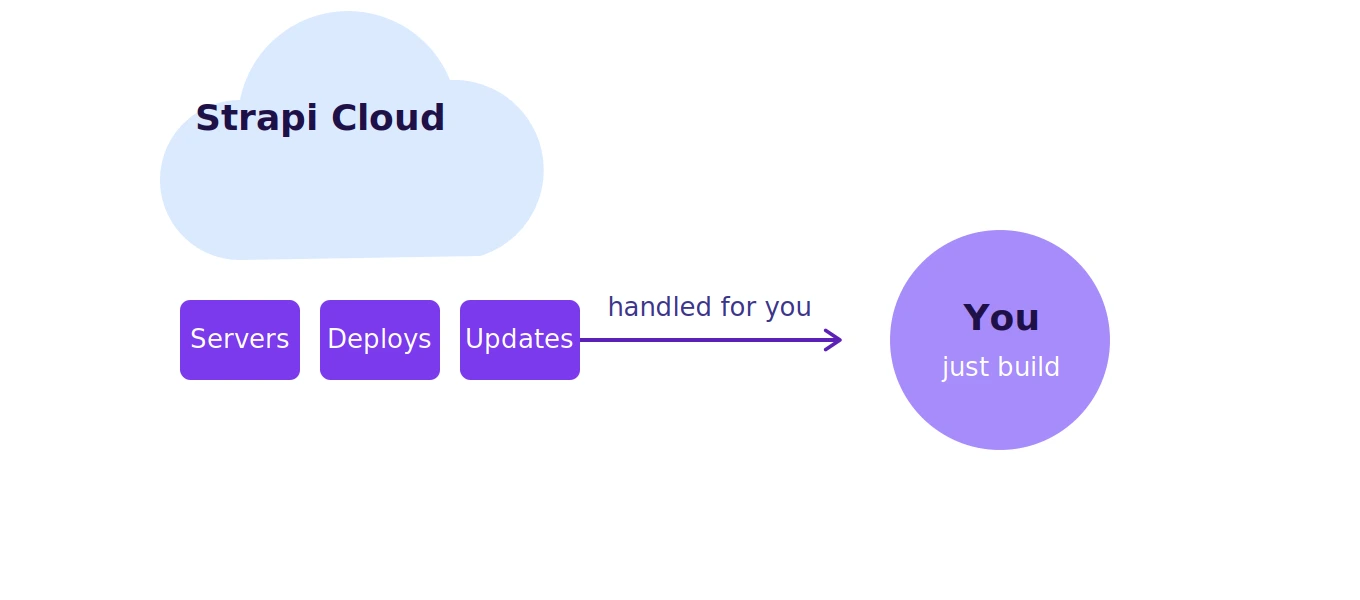
Strapi Cloud is Strapi's own managed hosting option. Instead of setting up and maintaining servers yourself, Strapi handles the infrastructure, deployments, and a lot of the operational overhead for you. You focus on building your content model and your application, and Strapi Cloud focuses on keeping it running.
This is the more convenient option, especially for teams without dedicated DevOps expertise. You get a much faster path from "let's build this" to "it's live," without needing to become an infrastructure expert along the way. Updates, scaling, and a lot of the operational complexity are handled on your behalf.
The tradeoff is less control and an ongoing subscription cost instead of (potentially cheaper, if you know what you're doing) self-managed server costs. You're also somewhat more tied to Strapi's own infrastructure decisions and pricing structure over time, rather than being able to shop around for the cheapest server that fits your needs.
Since Strapi Cloud's specific plans, pricing tiers, and features do change over time, it's worth checking Strapi's official pricing page directly for current details rather than relying on numbers that might be outdated by the time you're reading this.
Questions that actually help you decide
Rather than treating this as a simple cost comparison, it helps to ask a few honest questions about your own team and project.
Do you or your team already have experience managing servers and deployments? If yes, self-hosting might save money without adding much real burden, since you already have the skills in-house. If not, that "savings" often gets eaten up by the time spent learning, troubleshooting, and firefighting issues you weren't prepared for.
How much do you value predictable, hands-off maintenance versus having full control over your infrastructure? Teams that want to focus entirely on building their product, without thinking about servers, tend to prefer managed hosting. Teams with specific infrastructure requirements or a strong preference for full control tend to prefer self-hosting.
Are there compliance, data residency, or specific security requirements that dictate exactly where and how your data is hosted? If so, this can sometimes make the decision for you, regardless of convenience or cost, since certain requirements may only be satisfiable through a specific self-hosted setup.
What does your budget actually look like, in total? Remember to compare the full picture: server costs plus the value of the time someone spends managing it, versus a subscription cost that includes that management already baked in. A cheaper server isn't actually cheaper if someone's spending hours every month keeping it running smoothly.
There's no universally right answer here either
If you have the technical resources and want full control, self-hosting can absolutely be the more cost-effective and flexible choice long-term. If you'd rather focus your time on building your actual product and are willing to pay for that convenience, Strapi Cloud removes a real chunk of operational overhead from your plate.
Plenty of teams also start with Strapi Cloud to move fast early on, then migrate to self-hosting later once their needs, team, and budget justify taking on that responsibility. Strapi's open-source nature means that path stays open to you either way, which is honestly one of the underrated advantages of choosing Strapi in the first place.
If you've made this decision for your own project, whichever way you went, we'd genuinely like to hear how it's held up in practice. Real experiences with the tradeoffs involved are exactly the kind of content we want more of on this blog.