
If you're a US-based brand looking to sell online, chances are you've narrowed your options down to Shopify or WooCommerce fairly quickly. They're the two most commonly recommended platforms for e-commerce, and for good reason, both are mature, well-supported, and used by everyone from single-founder side businesses to brands doing millions in annual revenue.
But they're built on genuinely different foundations, and that difference matters a lot more once you're actually running a store, not just setting one up. Let's go through what actually separates them.
How each platform is structured
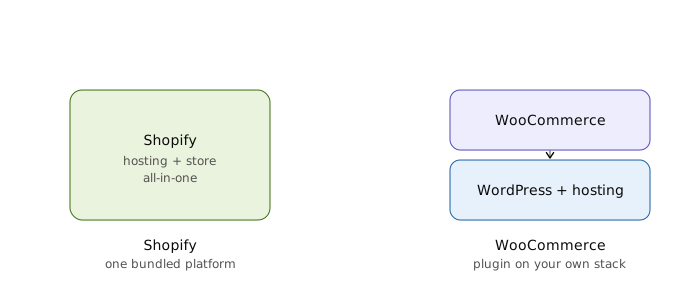
Shopify is a fully hosted, all-in-one platform. You sign up, pay a monthly subscription, and Shopify handles the hosting, security, updates, and infrastructure entirely. You're building your store within Shopify's ecosystem, using their tools and their rules.
WooCommerce is different. It's a free plugin that turns a WordPress site into an online store. That means you need WordPress hosting separately, and you're responsible for a lot of the technical maintenance that Shopify handles automatically. In exchange, you get WordPress's full flexibility as your foundation, not just an e-commerce add-on.
This single structural difference is really the root of almost everything else on this list.
Ease of setup and ongoing management
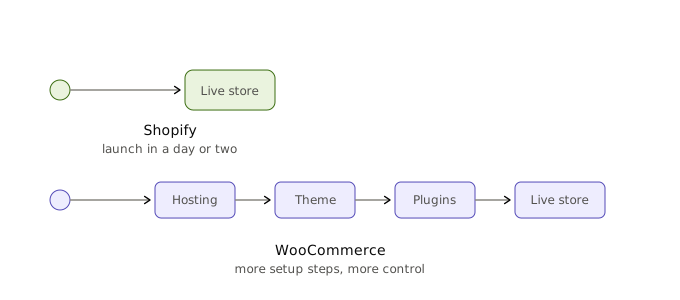
Shopify is built to get a store live fast, often within a day or two, even for someone without technical experience. The setup wizard, templates, and built-in tools are designed so a non-technical founder can go from idea to live store without hiring a developer.
WooCommerce takes more setup work. You need to handle WordPress hosting, install and configure the plugin, choose a compatible theme, and often piece together additional plugins for features Shopify includes out of the box. It's absolutely doable without deep technical skills, plenty of small business owners run WooCommerce stores themselves, but the learning curve and setup time are noticeably steeper.
If speed to launch and simplicity matter most to you, Shopify has a clear edge here.
Cost structure
This is where a lot of US brands get surprised, in both directions.
Shopify's monthly subscription cost is predictable and transparent on the surface, but real costs add up through premium themes, apps for additional functionality, and Shopify's own transaction fees if you don't use Shopify Payments (which isn't available or ideal for every US business situation). For a growing brand relying on several paid apps, monthly costs can climb higher than expected.
WooCommerce itself is free, but "free" doesn't mean no cost. You're paying for WordPress hosting, an SSL certificate, a quality theme, and likely several plugins to match features Shopify bundles in. For a lean setup, WooCommerce can genuinely be cheaper. For a feature-rich store, the costs can end up fairly comparable to Shopify once everything's accounted for, they're just distributed differently.
The honest answer is that neither platform is definitively cheaper across the board. It depends heavily on how many features and integrations your specific store actually needs.
Customization and control
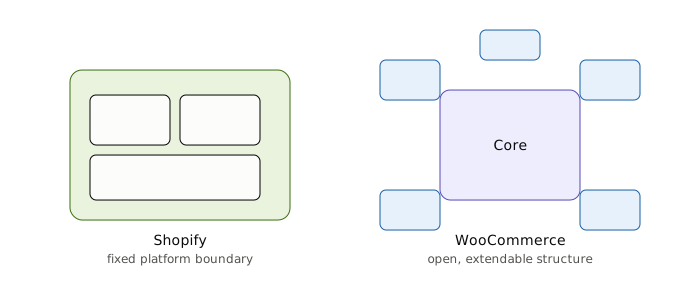
This is where WooCommerce, and WordPress underneath it, really pulls ahead.
Because WooCommerce runs on WordPress, you have access to WordPress's enormous plugin ecosystem and near-total control over design, functionality, and how your site is structured. If you want highly custom features, unique layouts, or specific integrations that don't fit into a typical e-commerce mold, WooCommerce gives you the flexibility to build almost anything.
Shopify is more restrictive by design. You're working within their platform's structure, and while there's a large app store to extend functionality, you're ultimately bound by what Shopify's architecture allows. For most standard e-commerce needs this isn't a real limitation, but for brands with unusual requirements, it can become one.
Payment processing and US-specific considerations
For US brands specifically, Shopify Payments (their built-in processor) is generally well supported and straightforward to set up, with competitive rates if you stay within the Shopify ecosystem. If you want to use a different payment processor, Shopify charges an additional transaction fee on top, which is worth factoring into your cost comparison.
WooCommerce doesn't lock you into a specific payment processor. You can integrate Stripe, PayPal, Square, or a range of other US-friendly processors directly, often without the extra transaction fee penalty Shopify applies for using an external processor. For brands that already have a preferred payment setup or negotiated rates with a specific processor, this flexibility matters.
Scalability and performance
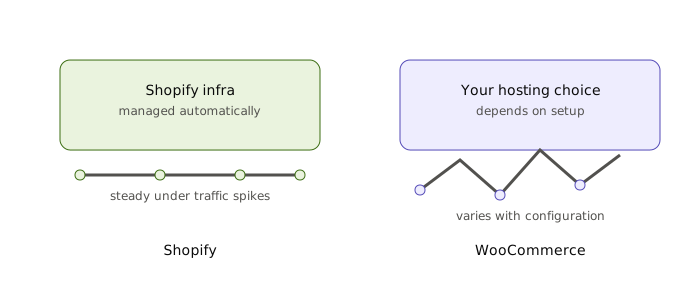
Shopify handles hosting and infrastructure for you, which means it scales well without you needing to think about server capacity, even during high-traffic periods like Black Friday. This is one of Shopify's strongest selling points for growing US brands that don't want to manage infrastructure themselves.
WooCommerce's performance depends heavily on your hosting choice and how well your site is optimized. A well-configured WooCommerce store on solid hosting can absolutely handle serious traffic and scale, plenty of large stores run on it successfully, but that scalability isn't automatic the way it is with Shopify. It requires more deliberate technical planning as you grow.
So which one fits your brand?
If you want to launch quickly, don't want to manage hosting or technical maintenance yourself, and are comfortable working within a more structured platform, Shopify is likely the better fit, especially for founders without a technical background or in-house development support.
If you want maximum flexibility and control, already have some WordPress experience or development support available, and want more freedom over payment processing and long-term costs, WooCommerce is probably the stronger choice, particularly if your store has specific custom requirements.
Neither platform is the objectively "better" choice for every US e-commerce brand. It comes down to how much control you want, how comfortable you are with technical setup, and what your specific store actually needs to do.
If you've run a store on either platform, or switched from one to the other, we'd genuinely like to hear how that decision played out in practice. Real experiences from actual US e-commerce brands are exactly the kind of content we want more of on this blog.