
Manufacturing websites have a reputation, and it's not always a flattering one. A lot of them look like they were built a decade ago and never touched again: a static product catalog, a PDF spec sheet nobody bothered to convert into a proper webpage, and a contact form that dumps into an inbox nobody checks. Meanwhile, the buyers researching these products are increasingly doing so the same way consumers shop, researching extensively online before ever contacting a sales rep.
That shift is part of why more manufacturing and industrial B2B companies have been taking a closer look at platforms like Umbraco. Let's talk through why it tends to fit this industry well, and what actually matters when you're managing a manufacturing website.
What manufacturing websites actually need
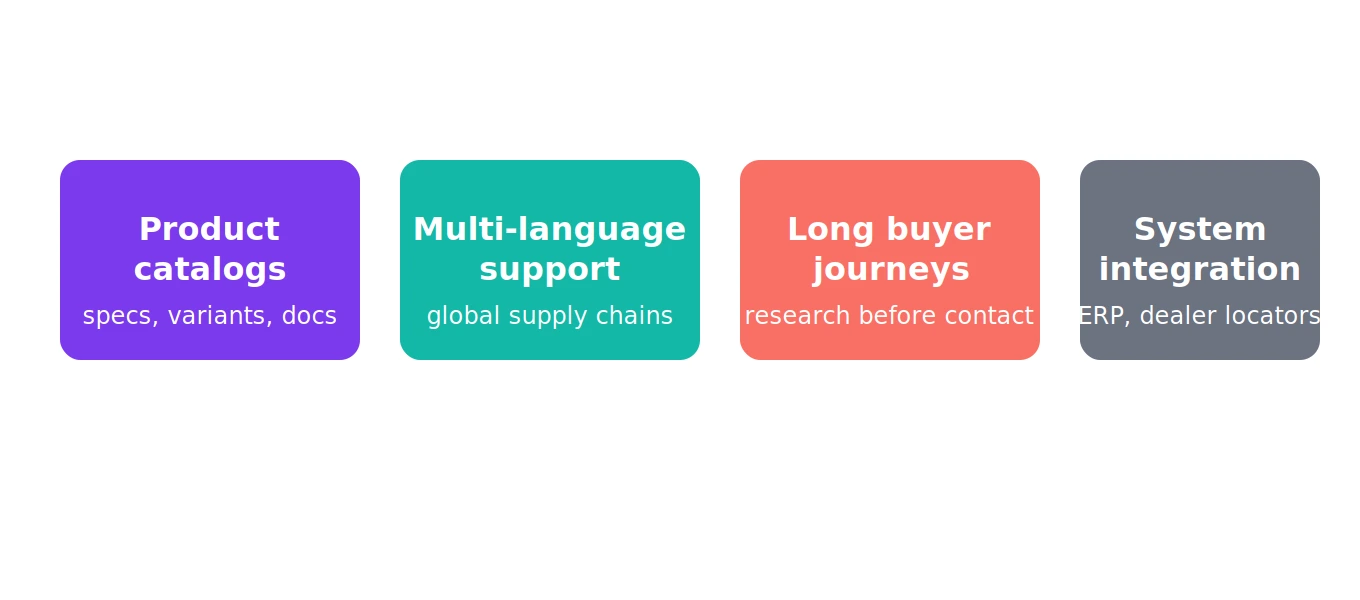
Manufacturing sites tend to have requirements that don't map neatly onto a typical business website template. You're often managing large, structured product catalogs with detailed specifications, technical documents, and variants that need to be organized and searchable, not just listed. You frequently need multi-language support if you sell internationally, which is common in manufacturing given how global supply chains tend to be. You need to support long, research-heavy B2B buyer journeys, where a single prospect might read spec sheets, case studies, and comparison content over weeks before ever filling out a form. And you usually need integration with other business systems, ERP data, distributor or dealer locators, quote request systems, rather than a website that exists in total isolation from the rest of the business.
A basic website builder or a simple CMS setup often starts to strain under these requirements pretty quickly.
Where Umbraco fits into this
Umbraco is built on .NET, which matters for a lot of manufacturing companies specifically because many already have .NET-based infrastructure and in-house development skills from other parts of the business, ERP systems, internal tools, existing enterprise software. Choosing a CMS that fits naturally into that existing technical ecosystem, rather than introducing a completely separate technology stack, is a real practical advantage.
Umbraco's content modeling flexibility is also a strong match here. Manufacturing product data is often deeply structured, product families, variants, technical specifications, downloadable documents, certifications, and Umbraco's approach to defining custom content types and structures handles that kind of complexity well without needing to force everything into a generic blog-post-shaped mold the way some simpler platforms do.
Multi-language and multi-site capabilities matter for manufacturers selling across regions or through different regional brands, and this is an area where Umbraco holds up well without needing extensive custom development to support it.
The buyer journey angle
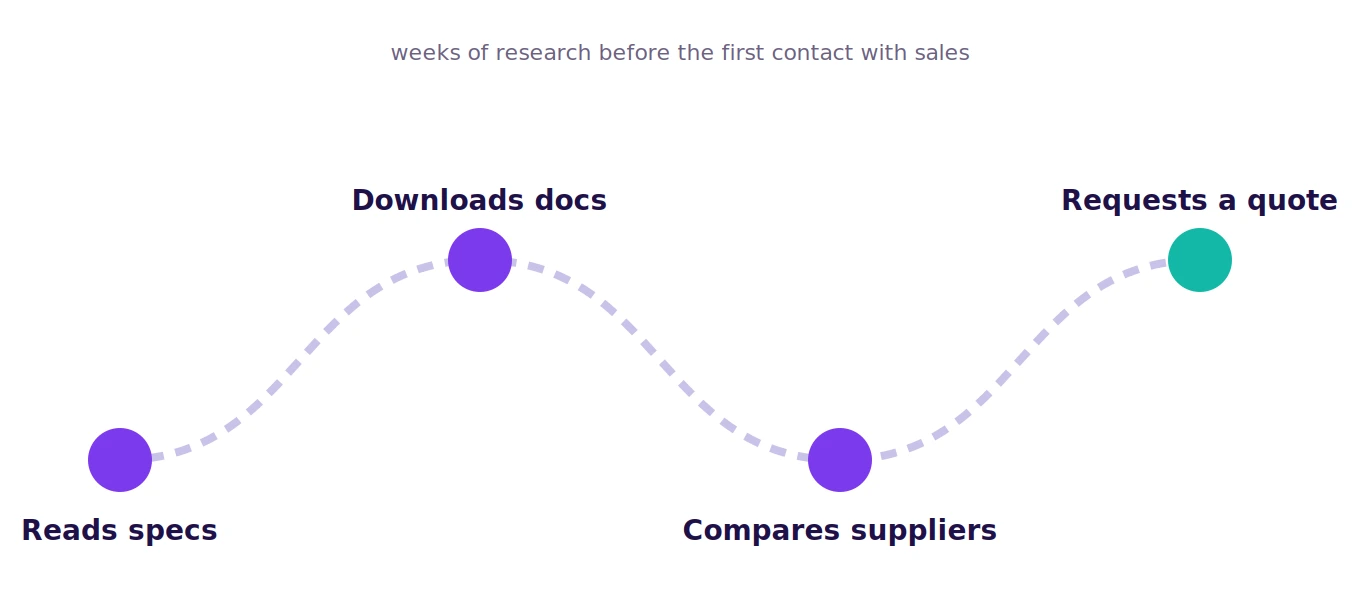
This is worth calling out specifically, because it's often underestimated in manufacturing. B2B buyers in this space typically don't make quick decisions. They're researching specifications, comparing suppliers, downloading technical documentation, and building a case internally before ever reaching out. A website that only supports "browse the catalog, fill out a contact form" misses most of that actual buyer journey.
Umbraco's flexibility supports building out the kind of content-rich experience this requires: detailed resource libraries, gated technical content, case studies organized by industry or application, and structured content that can be personalized or filtered based on what a visitor is actually looking for. This is closer to how modern B2B marketing actually works, rather than treating the website as a static digital brochure.
What to keep in mind before choosing Umbraco
Umbraco isn't the simplest platform to set up, and it does require .NET development expertise, which is a smaller talent pool than something like WordPress. If your organization doesn't already have .NET skills in-house or accessible through a development partner, that's worth factoring into the decision honestly.
It's also worth being clear that Umbraco alone doesn't solve integration challenges with ERP systems or other business tools automatically. That integration work still needs to be planned and built, Umbraco provides a solid foundation to build on, not a plug-and-play connection to every backend system your manufacturing business might already use.
Is it the right fit for your manufacturing business?
If your organization already works within a .NET ecosystem, has complex, structured product data to manage, sells across multiple regions or languages, and wants to build out genuinely useful content for a research-heavy B2B buyer journey, Umbraco is a strong platform worth serious evaluation. If your needs are simpler, a smaller catalog, a single region, straightforward content, a more mainstream platform like WordPress might get you there with less specialized development overhead.
As with most CMS decisions, it comes down to matching the platform's real strengths to your actual complexity, not choosing based on what a competitor happens to use.
If your manufacturing business has implemented Umbraco, or evaluated it against other platforms, we'd genuinely like to hear how that decision played out in practice. Real experiences from the manufacturing and industrial B2B space are exactly the kind of insight that's hard to find in generic CMS comparisons.