
If you've spent any time researching content management systems, you've almost certainly run into the WordPress vs Drupal debate. It's one of the oldest comparisons in the CMS world, and it keeps coming back around because both platforms are still genuinely strong choices, just for very different reasons.
WordPress powers a massive share of the websites you visit every single day, everything from personal blogs to major news outlets. Drupal has a smaller footprint but shows up constantly behind the scenes of large government sites, universities, and complex enterprise platforms. Both are open source, both have been actively developed for more than two decades, and both have huge, dedicated communities behind them.
So why does one company end up on WordPress and another on Drupal? It usually comes down to a handful of practical differences that matter a lot more once you're actually building and running a website, not just reading about it. Let's go through them properly.
Ease of use
This is where most people notice the difference immediately, often within the first ten minutes of logging in.
WordPress was built with simplicity as a core design goal from the very beginning. The dashboard is clean, adding a new blog post or page takes just a few clicks, and the block editor makes it fairly intuitive to lay out content without knowing any code. If you've handed WordPress access to a marketing person or a small business owner with no technical background, there's a good chance they figured out the basics within an afternoon, sometimes less.
Drupal takes a different approach. It's not badly designed, it's just built around more technical concepts from the start. You'll run into terms like content types, taxonomies, views, and fields fairly early on, and the admin interface asks you to think a bit more structurally about your content before you can start publishing. For a developer or someone with some technical background, this isn't a big deal. For a small team without that background, it can genuinely slow things down.
Here's the honest way to think about it: WordPress optimizes for getting content published quickly. Drupal optimizes for structuring content properly, even if that means a slower start. Neither approach is wrong, but they suit very different kinds of teams.
Flexibility and how each platform handles complexity
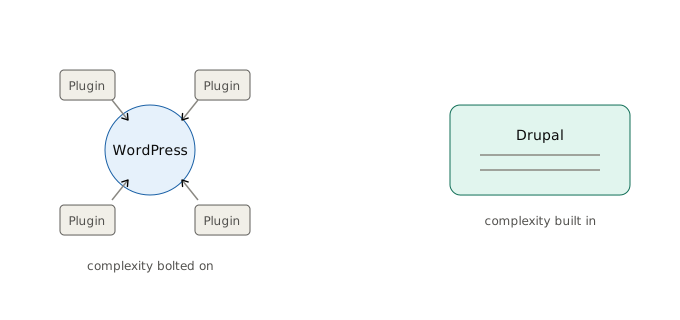
This is where the conversation usually shifts in Drupal's favor, especially once a project gets complicated.
Drupal was architected from day one to handle complex, structured content. Say you're building a site where you need multiple content types that all relate to each other in specific ways, think a university site with departments, courses, faculty profiles, and events all cross-referencing one another, or a large publisher managing hundreds of thousands of articles with detailed taxonomies. Drupal handles that kind of structural complexity natively, without needing a pile of third-party add-ons duct-taped together.
WordPress can technically do a lot of this too, but it usually means layering plugin on top of plugin to get there. Need custom content types? There's a plugin for that. Need complex relationships between them? Another plugin, or custom development. Each individual plugin might work fine on its own, but as they stack up, so does the complexity of keeping them all compatible with each other and with every WordPress core update. It's not that WordPress can't handle complexity, it's that the complexity tends to live in a patchwork of plugins rather than in the platform's core design.
If your project genuinely needs that structural complexity from the outset, Drupal will likely feel more solid and less fragile over time. If your needs are more straightforward, that same complexity in Drupal can feel like overkill.
The plugin and module ecosystem
WordPress's plugin library is enormous, by far the largest of any CMS platform. Whatever functionality you're trying to add, there's a very strong chance someone has already built a plugin for it, often several competing options to choose from. Want an SEO plugin, a page builder, a booking system, a membership site, an e-commerce store? All of that exists, often with free versions that cover most small business needs.
This is a huge part of WordPress's appeal. You can build a genuinely functional, feature-rich website without writing a single line of code, just by installing and configuring the right combination of plugins.
Drupal has modules that serve a similar purpose, and its ecosystem is solid and well-maintained, but it's noticeably smaller in raw volume compared to WordPress. What Drupal's ecosystem tends to lack in sheer quantity, it often makes up for in consistency and quality, particularly around enterprise-grade features like advanced permissions, multilingual support, and complex workflows. But if you're hoping to find a ready-made module for every small, specific feature idea the way you can with WordPress plugins, you won't always get that same instant convenience with Drupal.
Security
Both platforms can be made genuinely secure. Both can also be left vulnerable through neglect. But the way security risk tends to show up differs between them.
WordPress's core software itself is reasonably secure and actively maintained. Its bigger security weakness usually comes from the plugin and theme ecosystem, specifically outdated, poorly maintained, or abandoned third-party plugins. A WordPress site running a dozen plugins from a dozen different developers, some of which haven't been updated in years, has a meaningfully larger attack surface than a lean, well-maintained install using only a handful of actively supported plugins.
Drupal has built a strong reputation for security over the years, partly due to its architecture and partly due to a smaller, more tightly curated module ecosystem with a rigorous security review process for anything listed officially. This is a big part of why Drupal is so commonly chosen for government websites, financial institutions, and large enterprises where security requirements are strict and non-negotiable.
The takeaway here isn't "Drupal is safe, WordPress is risky." It's that WordPress's security is more dependent on your own discipline around which plugins you install and how well you maintain them, while Drupal's ecosystem does more of that filtering for you by default.
Performance at scale
For a modest website with a reasonable number of pages and moderate traffic, both platforms will perform just fine with decent hosting and basic optimization. This difference really only starts to matter once you're talking about serious scale.
Drupal tends to handle large-scale complexity more gracefully out of the box, sites with massive content volumes, heavy traffic, or intricate data relationships. Its architecture was built with that kind of scale in mind from early on, which is part of why it's a common choice for large publishers and institutions.
WordPress can scale to handle serious traffic too, there are plenty of massive, high-traffic websites running on it successfully, but getting there often requires more deliberate performance work: aggressive caching, a carefully chosen and pruned plugin stack, and sometimes specialized hosting built specifically for WordPress at scale. It's achievable, but it tends to require more active engineering attention as you grow, compared to Drupal's more scale-ready starting point.
Cost, hiring, and long-term resources
This is a practical consideration that often gets overlooked until it's too late.
WordPress is generally cheaper to get started with, and it's dramatically easier to find developers for. The talent pool is enormous, hosting providers widely support and optimize specifically for WordPress, and the sheer size of the ecosystem tends to keep costs more competitive across the board, from developers to plugins to hosting plans.
Drupal development tends to cost more overall, largely because Drupal-specific skills are more specialized and the pool of experienced Drupal developers is considerably smaller than the WordPress talent pool. If you're a small business with a tight budget, this alone can be enough to settle the decision in WordPress's favor. If you're a larger organization with a dedicated development budget and specific complex requirements, the higher cost of Drupal expertise might be entirely justified by what the platform gives you in return.
So, which one should you actually choose?
Here's the honest, unglamorous answer: it depends on what you're actually building, not on which platform "wins" in general.
If you're running a small to mid-sized website, want a team that isn't deeply technical to be able to manage content independently, and want access to the widest possible range of ready-made features through plugins, WordPress is very likely going to be the more practical, cost-effective choice.
If you're building something genuinely complex, with intricate content relationships, strict security and compliance requirements, or a real need to scale to enterprise-level traffic and content volume, and you have the budget and technical resources to support it, Drupal is probably going to serve you better in the long run.
Neither platform is objectively superior. They were built to solve different kinds of problems for different kinds of teams, and the right choice comes down to matching the platform to your actual situation, your team's technical comfort level, the complexity of your content, and your budget, rather than picking whichever name shows up first on a generic "best CMS" listicle.
If you've made this decision yourself, whether you went with WordPress, Drupal, or ended up switching from one to the other, we'd genuinely like to hear how it actually played out. Real experiences, including the messy, complicated parts, are exactly the kind of content we want more of on this blog.